
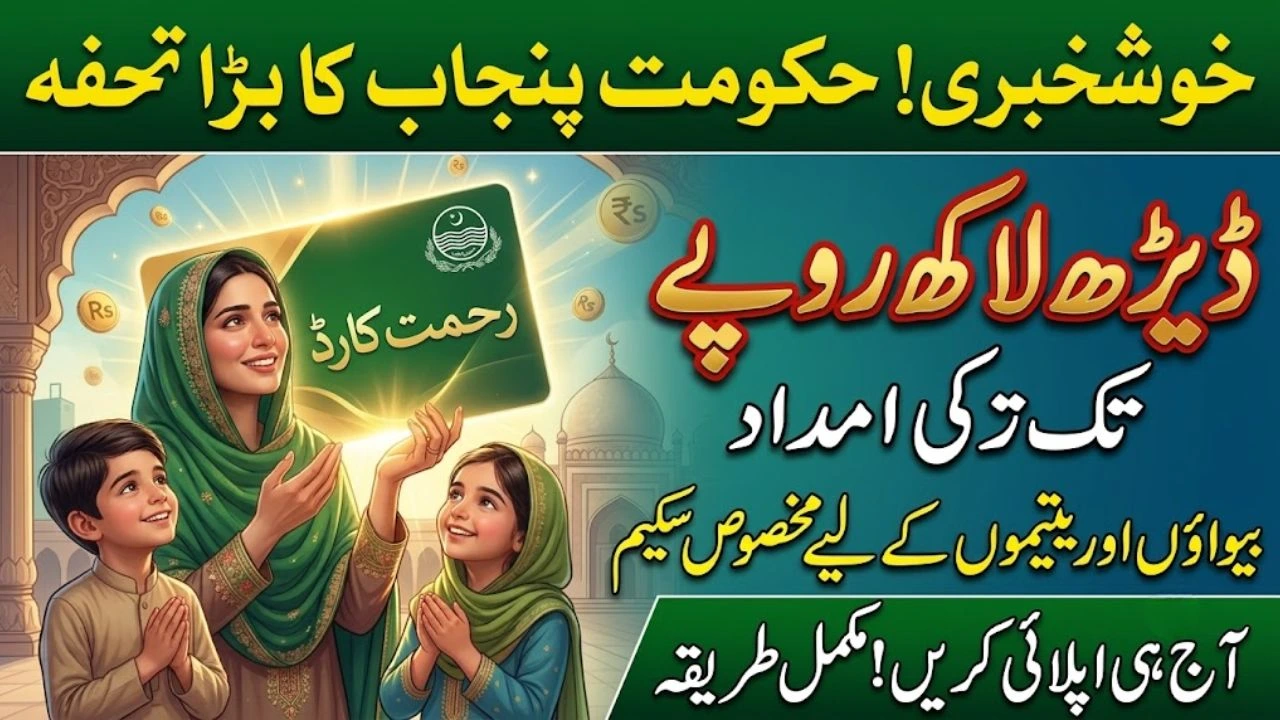
What is the Rahmat Card Program 2026?
The Rahmat Card Program 2026 is a landmark social welfare initiative launched by the Government of Punjab to provide structured financial assistance to widows and orphans across the province. With a dedicated budget of Rs 5 billion, this program represents one of the most significant targeted safety net interventions in Punjab’s recent history.
Unlike traditional charity-based approaches, the Rahmat Card introduces a dignified, rights-based framework — ensuring that the most economically vulnerable segments of Punjab’s population receive consistent, transparent, and verifiable financial support directly in their hands.
Key Highlights at a Glance
| Feature | Details |
| Program Name | Rahmat Card Program |
| Launched By | Government of Punjab |
| Target Beneficiaries | Widows and orphans (Zakat-eligible) |
| Phase 1 Coverage | 50,000 families |
| Total Budget | Rs 5 billion |
| Grant for Widows | Rs 100,000 |
| Grant per Orphan Child | Rs 25,000 |
| Maximum Per Family | Rs 150,000 |
| Disbursement Method | Biometric – Bank of Punjab & JazzCash |
| Helpline | 1077 |
| Official Portal | rahmatcard.punjab.gov.pk |
Who is Eligible for the Rahmat Card?
The Rahmat Card is specifically designed for Zakat-eligible widows and orphan children residing in Punjab. To qualify, applicants must meet the following criteria:
- Must be a resident of Punjab with a valid CNIC or B-Form
- Must fall under the Zakat-eligible income threshold
- Must be registered or registerable in the Punjab Socio-Economic Registry (PSER)
- Widows must have no earning male guardian in the household
- Orphan children must have lost their father and be dependents of the applying widow
The program uses NADRA and PSER database verification to confirm eligibility objectively, removing human bias from the selection process.
How Much Financial Assistance Does the Rahmat Card Provide?
The Rahmat Card offers a one-time structured grant designed to enable economic independence — not merely short-term relief:
 WhatsApp Channel
- Rs 100,000 — provided to the eligible widow as the primary beneficiary
- Rs 25,000 per orphan child — additional support for each dependent child
- Maximum grant of Rs 150,000 per family — capped to ensure equitable distribution across 50,000 families
This grant structure is intentionally designed so that a widow with two orphan children can receive the full Rs 150,000, giving families a meaningful capital base to invest in small businesses, livestock, education, or housing improvements.
How to Apply for the Rahmat Card Program 2026?
The Punjab Government has made the application process accessible through multiple channels to ensure no eligible family is left behind due to digital barriers:
1. Online Web Portal
Visit the official website: https://www.rahmatcard.punjab.gov.pk/ Complete the digital registration form with your CNIC details and household information.
2. Helpline — 1077
Call the 1077 helpline for guided registration assistance or to check your application status. This is especially useful for applicants in rural areas with limited internet access.
3. Zakat and Ushr Offices
Visit your nearest District Zakat and Ushr Office in person for in-office registration support and verification.
How is the Rahmat Card Amount Disbursed?
One of the defining strengths of the Rahmat Card Program is its fully digitized, tamper-proof disbursement system:
- Funds are transferred directly through Bank of Punjab accounts or JazzCash digital wallets
- Biometric verification is required at the point of disbursement to confirm identity
- This eliminates middlemen, prevents fraud, and ensures 100% of the grant reaches the intended beneficiary
- The entire payment trail is digitally recorded, enabling government auditors to track fund utilization in real time
This approach aligns with Punjab’s broader digital governance agenda and sets a new standard for welfare transparency in Pakistan.
The Role of PSER in Rahmat Card Selection
The Punjab Socio-Economic Registry (PSER) is the backbone of the Rahmat Card’s merit-based targeting system. PSER is a comprehensive household data registry that collects income, asset, and demographic information across Punjab.
By linking the Rahmat Card to PSER, the government ensures:
- Selection is based on objective socio-economic data, not political or administrative discretion
- Eligible families who are not yet registered in PSER can apply to be included before receiving benefits
- Cross-referencing with NADRA prevents duplicate registrations and ghost beneficiaries
This is a significant improvement over older welfare programs, where eligibility was often determined through manual surveys prone to errors and manipulation.
Why the Rahmat Card Program Matters for Punjab
Punjab is home to millions of widows and orphaned children, many of whom lack legal documentation, land rights, or access to formal financial services. The Rahmat Card addresses this gap by:
1. Providing Immediate Capital Relief A grant of Rs 100,000–150,000 is transformative for a household with no income. It can fund a small tailoring business, a cart for selling food, school fees for children, or repairs to a damaged home.
2. Formalizing Welfare Delivery By routing payments through Bank of Punjab and JazzCash, the program financially includes previously unbanked widows, giving them a formal transaction history and a gateway to other financial services.
3. Establishing a Dignity-First Model The program’s structure — fixed grants, biometric disbursement, no middlemen — treats beneficiaries as rights-holders, not charity recipients. This shift in philosophy is central to sustainable welfare reform.
4. Scaling a Replicable Model Phase 1 covers 50,000 families. The learnings from this phase — application rates, disbursement efficiency, fraud detection — will inform how the program scales in subsequent phases.
Rahmat Card vs Other Punjab Welfare Programs
| Program | Beneficiary | Amount | Delivery |
| Rahmat Card | Widows & Orphans | Rs 100,000–150,000 | Biometric / Digital |
| Ehsaas Kafaalat | Low-income women | Rs 10,500/quarter | Biometric ATM |
| Zakat Fund | Zakat-eligible poor | Variable | Manual / Office |
| BISP | Poorest households | ~Rs 9,000/quarter | Biometric ATM |
The Rahmat Card stands out for its higher per-household grant amount and its specific focus on widows and orphans — a demographic often missed by broader poverty programs.
Frequently Asked Questions (FAQs)
Q: Is the Rahmat Card only for Punjab residents?
Yes. In its current phase, the Rahmat Card is exclusively available to eligible residents of Punjab, Pakistan.
Q: Can a widow with no children apply?
Yes. A widow who is Zakat-eligible can apply and receive the base grant of Rs 100,000 even without orphan children.
Q: What documents are required for registration?
Applicants typically need a valid CNIC, proof of widowhood (e.g., husband’s death certificate), and PSER registration. Detailed documentation requirements are listed on the official portal.
Q: Is there a deadline to apply?
No official deadline has been announced for Phase 1 registrations as of June 2026. Interested applicants should register as early as possible to be considered for Phase 1 disbursement.
Q: How will I know if my application is approved?
Applicants will be notified via SMS to their registered mobile number or can check their status on the official portal or by calling helpline 1077.
Q: Can orphan children apply independently?
No. Orphan children must be part of a widow-headed household registered under the applying widow’s CNIC.
Contact and Official Resources
- Official Website: https://www.rahmatcard.punjab.gov.pk/
- Helpline: 1077
- In-Person Support: District Zakat and Ushr Offices across Punjab
- Application Methods: Web portal, mobile app, helpline, or office visit
Conclusion
The Rahmat Card Program 2026 is more than a financial grant — it is a policy statement about who Punjab’s government chooses to prioritize. By targeting widows and orphans with substantial, digitally disbursed grants backed by a merit-based registry, the program sets a new bar for inclusive, transparent, and dignified welfare in Pakistan.
If you or someone you know may be eligible, visit rahmatcard.punjab.gov.pk today or call 1077 for assistance.